
Site Header Logo
a
M
Lake Titicaca Adventure: The High-Altitude Wonder of the Andes

Lake Titicaca Adventure: The High-Altitude Wonder of the Andes

Lake Titicaca feels like an inland sea suspended in the sky. Straddling the border of Peru and Bolivia on the Andean Altiplano, it's famed for its intense blue water, big-sky sunsets, and the cultures that have thrived on the lake for centuries.
Fast facts and key statistics

Lake Titicaca, often described as South America’s largest lake by volume and surface area, is commonly listed as a freshwater lake, even though many sources mention that its water is slightly brackish.

Valuable stats to know when planning:

  • Elevation: about 3,810–3,812 m (12,500 ft) above sea level.
  • Surface area: about 8,372 km² (3,232 Square Miles)
  • Mean depth (Lago Grande): about 107 m; maximum depth: about 281 m 
  • Two basins: the larger Lago Grande (Lago Chucuito) and the smaller Wiñaymarka (Lago Pequeño), connected by the Strait of Tiquina 

A key clarification: Titicaca is often called the “highest lake in the world.” More accurately, Titicaca is the highest navigable lake in the world. In fact, there are plenty of smaller lakes at a higher altitude.

What to expect: two countries, two flavors of Titicaca

Lake Titicaca Two Flavous

Titicaca tourism has two typical gateways:

  • Peru’s side: based around Puno, with easy access to the famous Uros floating islands and longer island itineraries to Taquile and Amantaní.
  • Bolivia’s side: based around Copacabana, a smaller lakeside town and the classic launch point for Isla del Sol (Island of the Sun) and nearby sacred sites.

Both sides share the same high-altitude reality: the light is sharper, the nights are colder, and you'll feel the elevation, especially if arriving quickly from lowland cities.

The Peruvian side: Puno, the Uros, Taquile, and Amantaní

Puno Map Lake Titicaca

The Uros floating islands: “man-made” life on reeds

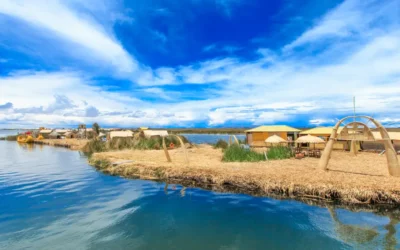
Visiting the Uros floating islands offers an iconic, unique experience; this living archipelago is built from totora reeds harvested from the shallows of Lake Titicaca. The reeds are not merely construction material; they are essential to daily life, with boats, crafts, and even food and fuel traditions closely linked to totora.

The islands are often described as man-made because they are assembled from layers of floating root mats and reeds, are anchored in place, and are constantly maintained as the lower layers decay.

Uros visits are typically short, half-day boat excursions from Puno, often paired with other islands on more extended tours.

Taquile: textiles, viewpoints, and island rhythm

Multi-island tours often include Taquile, known for its weaving and community traditions. The pace slows there with steep steps and expansive lake views, offering a distinct sense of living heritage.

Amantaní: homestays and starlit silence

To have a more immersive experience of Titicaca, consider staying overnight. This allows the location to feel less like a checklist item and more like an authentic experience. Many operators run 2D/1N itineraries that combine Uros, Amantaní, and Taquile. These itineraries often include a family homestay on Amantaní.

At night, the lake gets extraordinarily quiet, and the stars feel close enough to touch—it's one of the underrated wonders of traveling at this altitude.

The Bolivian side: Copacabana and Isla del Sol 

Copacabana Map Lake Titicaca

Copacabana: the relaxed launchpad

Copacabana is Bolivia’s most popular base for exploring Lake Titicaca, offering easy boat connections and a smaller, calmer atmosphere than Puno. Many travelers favor Copacabana for its relaxed lakeside atmosphere and easy access to the lake's most mythical island.

Isla del Sol: Inca mythology, terraces, and sacred landscapes

Isla del Sol, or Island of the Sun, is one of Titicaca’s most extensive and most storied islands, offering trails that connect small communities and provide scenic viewpoints over the water. Regular boat links connect the island to Copacabana, and it is widely associated with Inca sacred tradition and mythology.

What you’ll find: footpaths, ancient ruins/terraces, and long, cinematic views—especially in early morning or late afternoon light.

The “man-made islands” and other lake wonders: choosing the right cruise

Lake Titicaca Man Made Islands

Where to book cruises and island visits

Most so-called Titicaca “cruises” are not luxury mega-ship voyages; instead, they are boat tours that range from a few hours to multiple days. The two most common booking centers are:

  • Puno, Peru: day trips to Uros, and longer itineraries to Taquile and Amantaní (often 2D/1N with homestay).
  • Copacabana, Bolivia: boats/ferries to Isla del Sol (and sometimes Isla de la Luna), usually as day trips or overnight hikes on the island.

What to look for when choosing a tour:

  • Time on the islands: some itineraries rush; others build in walking and community interaction.
  • Group size: Smaller groups often feel more respectful and immersive.
  • Overnight option: if you can spare it, an overnight on Amantaní (Peru side) or Isla del Sol (Bolivia side) changes the whole feel of the lake.

How to access Lake Titicaca

Getting to the Peruvian side (Puno)

Most travelers reach Puno via:

  • Flight to Juliaca (Inca Manco Cápac International Airport), then transfer to Puno (standard approach), or
  • Bus/train routes from Cusco/Arequipa (popular overland circuits).

Getting to the Bolivian side (Copacabana)

Most travelers reach Copacabana via:

  • La Paz → Copacabana overland route, often including a crossing at the Strait of Tiquina area and (for some itineraries) border formalities if continuing into Peru.

Acclimatize to the altitude by sleeping, hydrating, and planning a lighter first day, whether arriving from Cusco, La Paz, or Lima.

A brief historical overview: why Titicaca matters

Lake Titicaca - Why The Lake Matters

Lake Titicaca is not only scenic but also deeply historic and sacred. The region has long been home to Indigenous cultures of the Altiplano. The lake features prominently in Andean cosmology and Inca tradition, with sites like Isla del Sol woven into origin stories. Archaeological interest extends underwater. Documented investigations have revealed artifacts around reefs and islands.

Tourism realities and helpful planning facts

  • Best time to visit: Many travelers prefer the dry season (roughly May–October) for clearer skies and steadier boat conditions; the wet season (roughly Nov–March) can bring dramatic skies but more rain and occasional travel disruptions. (If you want, tell me your travel month and I’ll tailor a weather/packing plan.)
  • Time to allocate to explore the lake:
  • 1 day: Uros + quick lake views (fast but common)
  • 2 days: Uros + Taquile or Uros + Amantaní (better)
  • 3+ days: add Isla del Sol on the Bolivian side for a richer “two-country” Titicaca

Titicaca is a place where geography and culture are inseparable. It is a high-altitude lake with a sea-like scale, home to communities that engineered life on reeds, and features island landscapes holding centuries of memory. If you tell me whether you're starting in Cusco, La Paz, or Lima, I can map a tight itinerary with realistic travel times for Peru, Bolivia, or a cross-border loop.

Discover Europe’s Number One Wonder Of The World – The Colosseum

Discover Europe’s Number One Wonder Of The World – The Colosseum

The Colosseum, located in the heart of Rome, Italy, is one of the world’s most iconic wonders and a testament to ancient Roman engineering, culture, and entertainment. Known for its massive scale and grandeur, it captivates the imagination of millions each year. Built nearly two millennia ago, the Colosseum symbolizes both the strength and complexity of the Roman Empire. This article explores its history, construction, legacy, and essential details for prospective visitors.

How and When the Colosseum Was Built

Construction of the Colosseum began in 72 AD under Emperor Vespasian of the Flavian dynasty, primarily using travertine stone, volcanic tuff, and concrete. The Romans employed advanced techniques, with stones held together by iron clamps for added stability. The structure was completed around 80 AD under Emperor Titus, Vespasian’s son. Measuring 620 by 513 feet and standing over 150 feet tall, it could accommodate 50,000 to 80,000 people, making it the largest amphitheater in the ancient world. Its elliptical design allowed for excellent sightlines, while a system of trapdoors and lifts facilitated elaborate stage settings.

The Colosseum’s Purpose and Uses

colosseum purpose

The Colosseum was built for public spectacles, including gladiatorial games and other forms of entertainment, often attended by large crowds. Gladiators, typically slaves or prisoners, would engage in combat against each other or wild animals, symbolizing Roman authority over both humans and animals. In addition to gladiatorial combat, the Colosseum hosted mock sea battles, dramatic reenactments, executions, and mythological plays. These events showcased the might and ingenuity of the Roman Empire, serving as a demonstration of power and entertainment for the people.

Duration of Operation and Decline

The Colosseum was used for over 400 years, though its purpose evolved as the Roman Empire changed. By the 5th century, gladiatorial games had begun to wane, influenced by economic pressures and the rise of Christianity. As the Empire declined, funding dried up, and the Colosseum’s grandeur faded. Over time, earthquakes, fires, and looting damaged the structure, with stones repurposed for other buildings in Rome. By the 12th century, it had largely been abandoned, only to gain renewed interest in the 18th century, which led to preservation efforts.

Controversies Surrounding the Colosseum

colosseum controversies

The Colosseum has been both admired and criticized. While it showcases ancient Roman architectural achievements, it also reminds us of the brutality of the past. Gladiatorial games were violent and exploited prisoners, slaves, and animals, raising ethical questions about deriving entertainment from suffering. Modern restoration efforts also spark debate; while preservation is essential, some argue extensive renovations detract from its authenticity.

Modern Popularity and Visitor Statistics

Today, the Colosseum draws between 7 to 8 million visitors annually due to its rich history and cultural significance as a UNESCO World Heritage site and one of the New Seven Wonders of the World, on par with gems such as Machu Picchu. Its proximity to famous landmarks, such as the Roman Forum and Palatine Hill, enhances its appeal as a must-see destination in Rome.

Visitor Information

Hours: Generally open daily, with hours changing seasonally, from 8:30 AM to sunset.
Tickets: Available for advance purchase online, often including entry to the Roman Forum and Palatine Hill.
Guided Tours: Recommended for a more profound experience, some tours offer access to restricted areas, like the underground chambers.
Accessibility: The ground floor is wheelchair accessible; however, the upper levels may be more challenging.
The Best Time to visit is early morning or late afternoon, especially during the peak summer season, to avoid crowds.

Nearby Attractions

colosseum palatine hill

Roman Forum: Once the center of public life, showcasing ruins of government buildings, temples, and marketplaces.
Palatine Hill, known as one of Rome’s Seven Hills, boasts ancient ruins and offers panoramic city views.
Arch of Constantine: A triumphal arch near the Colosseum commemorating Emperor Constantine’s victory.
Capitoline Hill and Museums: Located near the Forum, these museums showcase art and artifacts from ancient Rome.
Piazza Venezia and the Vittoriano: A large square featuring the Vittoriano monument and a rooftop terrace with city views.

Summary

The Colosseum is more than an architectural marvel; it embodies Rome’s rich history and enduring legacy. Having evolved alongside Rome from a venue for brutal spectacles to a cultural icon, the Colosseum offers insight into the glories and contradictions of the Roman Empire, inviting reflection on the complexities of human history.